Monday, 5 August 2013

“Make parents’ nod must for love marriages”

Paattali Makkal Katchi (PMK) leader S. Ramadoss, who has run a campaign against inter-caste marriages, now wants the government to amend the Hindu Marriage Act to make the consent of parents compulsory if a girl wants to marry before she is 21.
In a statement here, he referred to a suggestion by a Division Bench of the Karnataka High Court in 2011 that “in the case of love affair of a girl, who is below the age of 21 years, there shall be a condition that the parents of the girl should approve the marriage; otherwise such marriages shall be declared void or voidable.”
S. Ramadoss
Dr. Ramadoss said the Karnataka High Court had explained the “untold misery and hardship” of parents of teenage girls falling in love. The legal age for marriage for girls is 18.
He also referred to a dispute between Tamil film-maker Cheran and his daughter over her intention to marry an assistant director. The daughter, Kamani, has filed a complaint with the Chennai Police accusing her father of threatening her lover.

“I can understand the pain of Cheran as a father,” he said and added that he agreed fully with Mr. Cheran’s argument that a father could not accept a bad character as his son-in-law.
Dr. Ramadoss said it was a good gesture on the part of the City police advising Mr. Cheran’s daughter to complete her studies before getting married even though she and her lover had reached marriageable age. 

“If the police had followed the same principle and advised Divya and Ilavarasan of Dharmapuri, Divya’s father would not have committed suicide and all the unwanted things that followed the death could have been averted,” he said.

Ilavarasan’s watch gives time of impact:

Investigators probing the death of the Dalit youth E. Ilavarasan have more evidence to suspect that it was a case of suicide, though his family is alleging that it could be a murder.This time, it is the watch of the victim recovered from the scene where his body was found along the railway track on July 4 in Dharmapuri.

The watch stopped functioning at 1.20 p.m. On suspicion that the watch came apart when Ilavarasan was hit by the speeding train, police sought to know the exact time when the Coimbatore-Mumbai Kurla Expressed crossed the location.

Five die as earth caves in on road


Earth and rubble that caved in over the road in a landslip at Cheeyappara on the Kochi-Dhanushkodi road on Monday.
— Photo: H. Vibhu .

Earth and rubble that caved in over the road in a landslip at Cheeyappara on the Kochi-Dhanushkodi road 

Landslips triggered by heavy downpour claimed six lives in the high range Idukki district of Kerala on Monday.

Five persons were killed and many others are feared buried under rubble after the earth caved in over vehicles and shops at Cheeyappara, near Kothamangalam, on the Kochi-Munnar road on Monday.
The bodies of the five persons were recovered from under the rubble.
In separate landslips elsewhere in Idukki district since Sunday night, eight others were killed, taking the toll to 13. Four persons who were rescued at Cheeyappara were rushed to the Adimaly government hospital. The condition of one of them is stated to be serious.
Search and rescue operations are under way despite heavy rain that has made the effort extremely difficult.
Those killed in the landslip were Rajan, driver at the Devikulam taluk office; Thoppilkudy Josy, and Palakkad resident Jibin and two unidentified persons.
Those trapped in the mass of rubble that crashed down from a height of around 20 feet included tourists who had stopped over to watch rescue operations following an earlier landslip, and rescue workers, who were engaged in clearing the road.
A mini tourist bus, a jeep belonging to the revenue department and a few motor cycles were buried in the rubble from the landslip or swept away in the flash floods that followed in its wake.
Police and Fire and Rescue Service personnel from Adimaly and Neriyamangalam, with the support of the local people, are continuing the rescue operations. The landslip occurred between 7.30 a.m. and 8 a.m., said Janardhanan, a casual worker with the National Highways Authority.
He said that he was clearing the debris of a minor landslip near here when the second one occurred. He rushed to the spot to find that an entire hill had caved in, completely blocking the road. Hasainar, a driver, one of those who reached the spot first, said that he could not initially comprehend what had happened as out of the nearly 20 shops in the area, 10 were buried beneath the rubble.
Aliyar, a fire and rescue service personnel, said that the human toll could have been reduced had the tourist vehicles not halted to watch the first landslip. It was during that time that the hill caved in over their vehicles.
It was a tough time for the police to control the bulging crowd which reached the area. The continuing rain also hampered the rescue operations.
In a landslip at Thadiayanpadu near Cheruthoni, two sisters were killed when earth caved in on their house.

3 killed, 11 hurt as building under construction collapses in Kengeri:

Three workers were killed and 11 injured when a building under construction collapsed in Kengeri Satellite Town on Monday morning.

The labourers were constructing a three-storey marriage hall at Bandeswamy Math in Kommagatta. The moulding of the second floor’s ceiling was under way when it collapsed. At least 25 workers were on the roof when the accident occurred at around 10 a.m. Some workers fell from the roof while others on the ground floor were trapped under the debris.
Fire and Emergency Services personnel along with advanced rescue vehicles rushed minutes after the collapse. Officials said three bodies had been removed from the debris while a few injured workers were taken to nearby hospitals.

Labourers at the site said over 100 workers from Tamil Nadu, Bihar, Andhra Pradesh and Karnataka were at work for the last six months. Some 70 workers were on the ground floor mixing cement and doing other work. Some 25 workers were on the roof. Lalchand (30), one of the labourers injured, toldThe Hindu : “All I remember is that the building collapsed and I was trapped under the debris till some people pulled me out.” The injured were rushed to Rajarajeshwari hospital and Shreya hospital nearby.

The victims have been identified as Venkateshappa (40) from Andhra Pradesh, Shivanna (25) from Gulbarga and Sumit Mondal Khapari (24) from Bihar. Shivanna, who was laying the concrete on the roof, came plummeting down while the other two workers were working on the centring and were trapped underneath the debris.
Fire and Emergency Services personnel along with the police involved in rescue operations at the building that collapsed in Kengeri on Monday.— Photo: K. Murali Kumar

Police suspect a weak centring led to the collapse. A senior official said the centring was built of wood for a height of 25 feet.

This rendered the building unstable, they said. It was a serious case of negligence on the part of the building authorities, the police added. It is owned by the Eka Bilva Bande Veerashaiva Math.

Cases have been booked under Section 304 (culpable homicide not amounting to murder) against contractor Krishnamurthy, centring supervisor Murthy, engineer Jagannath Rao and Sachidananda Swami of the Math. Murthy and Krishnamurthy have been arrested.

Telangana fallout: Demand for smaller states hits Parliament

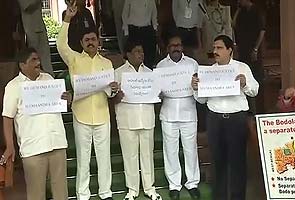
The uproar over the creation of a separate Telangana state from Andhra Pradesh resonated in Parliament today with many Members of Parliament who were against the government's decision raising slogans in both the Houses.

Rajya Sabha was briefly adjourned after protests by these MPs. In the Lok Sabha, many leaders were heard shouting, "We want justice."

Many banners were also seen in both Houses of Parliament demanding statehood for other regions. Parliamentarians from the Bodoland region in Assam staged a protest in Parliament premises with their demand for a separate statehood. "Bodoland's demand is a very genuine and legitimate demand. It is the right of the Bodo people. If they can give Telangana then why can't we have Bodoland? We want similar kind of justice," said S K Bwismuthiary, an MP from Kokrajhar in Assam.

Telangana fallout: Demand for smaller states hits Parliament

The government's announcement last week that Telangana will be created as India's 29th state has upset many Congressmen from Andhra Pradesh. The ministers said they had been assured that a high-level panel would be set up to address concerns of coastal and southern Andhra Pradesh. Several Congress ministers and lawmakers from these two regions have been on a resignation spree, amid angry protests outside their homes since the announcement.

The party has been on a firefighting mode since it announced the creation of Telangana. The new state will take at least six months to become a reality.
Residents and leaders of Telangana, which includes the IT hub of Hyderabad, are celebrating the fruition of a five-decade-long movement for statehood, but the other two regions of the state, coastal Andhra and Rayalaseema, say they have been betrayed

    Kirobo is world's first talking robot sent into space

    Japan has launched the world's first talking robot into space to serve as companion to astronaut Kochi Wakata who will begin his mission in November.
    One giant leap for robotkind! The world's first talking robot astronaut - Kirobo - was successfully blasted into space on August 4 by Japanese scientists.

    The robot was designed to be a companion for astronauts to stop them from getting lonely while in space.
    Officials at the Japan Aerospace Exploration Agency said the H2B rocket, carrying food, water and other supplies, lifted off from the island of Tanegashima today.

    Included in the cargo is a small robot named Kirobo, which will serve as a companion for Japanese astronaut Koichi Wakata who will join the crew later this year.

    Kirobo was put through a series of zero-gravity and other safety tests before it was deemed ready for flight.
    The name of Kirobo is a merging of Kibo and robot, project officials have said.

    Kirobo and Mirata were built by scientists and engineers at the University of Tokyo.

    Both robots come equipped with voice-recognition and face-recognition technology, as well as a camera, emotion recognition software and natural language processing.

    "I want to help create a world where humans and robots can live together," Kirobo told reporters when the project was unveiled.
    The android took off from the island of Tanegashima in an unmanned rocket also carrying supplies for crew onboard the International Space Station (ISS).

    Measuring 34cm (13 inches), Kirobo is due to arrive at the ISS on 9 August.
    It is part of a study to see how machines can lend emotional support to people isolated over long periods.
    The launch of the H-2B rocket was broadcast online by the Japan Aerospace Exploration Agency (Jaxa).
    The unmanned rocket is also carrying drinking water, food, clothing and work supplies to the six permanent crew members based at the ISS.
    Kirobo with developer Tomotaka TakahashiTomotaka Takahashi with his creation
    'Giant leap'Kirobo's name derives from the Japanese words for "hope" and "robot".
    The small android weighs about 1kg (2.2 pounds) and has a wide range of physical motion. Its design was inspired by the legendary animation character Astro Boy.
    Kirobo has been programmed to communicate in Japanese and keep records of its conversations with Mr Wakata who will take over as commander of the ISS later this year.
    In addition, it is expected to relay messages from the control room to the astronaut.
    "Kirobo will remember Mr Wakata's face so it can recognise him when they reunite up in space," the robot's developer, Tomotaka Takahashi said.
    "I wish for this robot to function as a mediator between a person and machine, or a person and the Internet, and sometimes even between people."
    The biggest challenge was to make the android compatible with space, Mr Takahashi added.
    Dozens of tests were carried out over nine months to ensure Kirobo's reliability.
    Kirobo has a twin robot on Earth called Mirata, which will monitor any problems its electronic counterpart may experience in space.
    "It's one small step for me, a giant leap for robots," Mirata said of the mission last month.
    Robot astronaut Kirobo is launched towards the ISS

    The endeavour is a joint project between Mr Takahashi, car producer Toyota and advertising company Dentsu.

    Three killed as Sri Lankan Army clamps down on protesters

    Boots on civilian turf:Sri Lankan troops chase protesters, up against contamination of drinking water in Weliweriya on Thursday. — PHOTO: AFP
    Boots on civilian turf:Sri Lankan troops chase protesters, up against contamination of drinking water in Weliweriya 


    Three young men have been killed over the last couple of days following a clash between the army and residents of Weliweriya — about an hour’s drive from Colombo — during protests against contaminated drinking water. At a time when the army’s growing dominance — even in civil matters — is being condemned by many sections within and outside the country, the incident has sparked severe criticism on the need for the army to be summoned in response to a protest over a basic civic problem.
    The army reportedly swung into action to “tackle” the protesters and the subsequent firing claimed three lives, in addition to leaving many seriously injured.

    Akila Dinesh (17), a student, died on Thursday night soon after the clash, while Ravishan Perera (19), who was admitted to the National Hospital, succumbed to injuries on Saturday, news agency Adaderana reported. On Sunday, a 29-year-old man, who was undergoing treatment at the Colombo National Hospital, also died.

    Following contamination of water in their wells — their primary ground water source — by effluents from a nearby factory, thousands of Weliweriya residents staged a protest on Thursday. Though the residents had been highlighting the issue for a while, there was no response or action from civic authorities. They even explored legal options, moving the magistrate court with a petition against the owner of the factory, Dipped Products Ltd, a subsidiary of Hayleys Group located at Nedungamuwa, about 3 km from Weliwveriya, The Sunday Times reported. However, the adjournment of the case until August 22 resulted in the protest gaining momentum, as more residents took to the streets on Thursday to express their anger and concern. The road from Kandy to Colombo was blocked — except for access given to school vehicles and ambulances.

    The army personnel were soon at the spot, trying to “control” the crowd. Many sections in Sri Lankan believe that while the police ought to have intervened in such a situation, the army’s presence and action cannot not justified. The Lawyers Collective condemned the government’s “continuous ferocity” against peaceful protesters.

    In a statement issued in this connection, the Collective said the government has displayed total disrespect to the constitutional guarantees on civil liberties of its citizens. “Evidence clearly establishes that deplorable levels of force including live bullets were used on the unarmed villager. The assailants also assaulted journalists and grabbed their cameras by force when they were doing their job covering the event.”
    The legal fraternity urged the government to control its military and ensure that they are used for only legitimate purposes.

    Journalists of the local media, at the spot to cover the developments, said army personnel threatened to “smash” their cameras. “There was a power cut soon after the clash that made some of us suspicious,” a journalist told The Hindu .

    Meanwhile, the Sri Lanka Human Rights Commission has begun investigating the incident, with a five-member team probing available evidence.


    The army, which has been denying charges against it, too has ordered an investigation into the incident.

    Saturday, 3 August 2013

    Atherosclerosis a overview

    Atherosclerosis  is a condition in which an artery wall thickens as a result of the accumulation of fatty materials such as cholesterol and triglyceride. It is a syndrome affecting arterial blood vessels, a chronic inflammatory response in the walls of arteries, caused largely by the accumulation of macrophage white blood cells and promoted by low-density lipoproteins (LDL, plasma proteins that carry cholesterol and triglycerides) without adequate removal of fats and cholesterol from the macrophages by functional high-density lipoproteins (HDL) . It is commonly referred to as a hardening or furring of the arteries. It is caused by the formation of multiple plaques within the arteries.
    The atheromatous plaque is divided into three distinct components:
    1. The atheroma, which is the nodular accumulation of a soft, flaky, yellowish material at the center of large plaques, composed of macrophages nearest the lumen of the artery
    2. Underlying areas of cholesterol crystals
    3. Calcification at the outer base of older/more advanced lesions.

    Pathology
    Atherosclerosis is a chronic disease that remains asymptomatic for decades. Atherosclerotic lesions, or atherosclerotic plaques are separated into two broad categories: Stable and unstable (also called vulnerable). The pathobiology of atherosclerotic lesions is very complicated but generally, stable atherosclerotic plaques, which tend to be asymptomatic, are rich inextracellular matrix and smooth muscle cells, while, unstable plaques are rich in macrophages and foam cells and the extracellular matrix separating the lesion from the arterial lumen (also known as the fibrous cap) is usually weak and prone to rupture. Ruptures of the fibrous cap expose thrombogenic material, such as collagen to the circulation and eventually induce thrombus formation in the lumen. Upon formation, intraluminal thrombi can occlude arteries outright (e.g. coronary occlusion), but more often they detach, move into the circulation and eventually occluding smaller downstream branches causing thromboembolism . Apart from thromboembolism, chronically expanding atherosclerotic lesions can cause complete closure of the lumen. Interestingly, chronically expanding lesions are often asymptomatic until lumenstenosis is so severe (usually over 80%) that blood supply to downstream tissue(s) is insufficient, resulting in ischemia.
    These complications of advanced atherosclerosis are chronic, slowly progressive and cumulative. Most commonly, soft plaque suddenly ruptures , causing the formation of a thrombus that will rapidly slow or stop blood flow, leading to death of the tissues fed by the artery in approximately 5 minutes. This catastrophic event is called an infarction. One of the most common recognized scenarios is called coronary thrombosis of a coronary artery, causing myocardial infarction (a heart attack). The same process in an artery to the brain is commonly called stroke. Another common scenario in very advanced disease is claudication from insufficient blood supply to the legs, typically caused by a combination of both stenosis and aneurysmal segments narrowed with clots.
    Atherosclerosis affects the entire artery tree, but mostly larger, high-pressure vessels such as the coronary, renal, femoral, cerebral, and carotid arteries. These are termed "clinically silent" because the person having the infarction does not notice the problem and does not seek medical help, or when they do, physicians do not recognize what has happened.

    Angioplasty
    Angioplasty is the technique of mechanically widening narrowed or obstructed arteries, the latter typically being a result of atherosclerosis. An empty and collapsed balloon on a guide wire, known as a balloon catheter, is passed into the narrowed locations and then inflated to a fixed size using water pressures some 75 to 500 times normal blood pressure (6 to 20 atmospheres). The balloon forces expansion of the inner white blood cell/clot plaque deposits and the surrounding muscular wall, opening up the blood vessel for improved flow, and the balloon is then deflated and withdrawn. A stent may or may not be inserted at the time of ballooning to ensure the vessel remains open.(Image of stent given below)

    Friday, 2 August 2013

    A True Leader- Velupillai Prabhakaran

     
    Velupillai Prabhakaran   was the founder and leader of theLiberation Tigers of Tamil Eelam (the LTTE or the Tamil Tigers), a militant organization that sought to create an independent Tamil state in the north and east of Sri Lanka. For over 25 years, the LTTE waged a violent secessionist campaign in Sri Lanka 
    Tamil Eelam
    The Tamil people of the island of Ceylon (now called Sri Lanka) constitute a distinct nation. They form a social entity, with their own history, traditions, culture, language and traditional homeland. The Tamil people call their nation 'Tamil Eelam'. 

    As a nation, Tamils have the inalienable right to self-determination, a universal principle enshrined in the U.N. Charter that guarantees the right of a people to political independence. 

    Apart from the right to self determination, the Tamil Eelam may also be justified in terms of international law under the concept of reversion of sovereignty and the concept of effectiveness. 

    Before a succession of western nations (including the Portuguese, Dutch and the British) ruled the island, there were two distinct kingdoms on the island, the Tamil Kingdom in the north and the Sinhala kingdom in the South. 

    For ease of administration, the British amalgamated the two distinct nations into a single entity with its capital in Colombo. The British gave Ceylon independence in 1948, handing over control of the entire island to a Sinhalese government, based in Colombo, which renamed the island Sri Lanka. 

    The Sinhala state's oppression of the Tamil people began in various forms almost immediately, attacking everything that defined the Tamils as a nation. 

    A series of laws that discriminated against Tamils were implemented. These included making Sinhala, instead of English, the only official language of the country, i.e. Tamils could not be employed unless they learnt Sinhala. The educational structures were altered to restrict Tamil admissions to higher education. Investment in Tamil areas was minimised. 

    Recruitment of Tamils into the security forces was restricted. The Sri Lankan security forces are almost exclusively Sinhalese. The security forces have been responsible for and continue to carry out human rights abuses and atrocities against Tamil civilians on a genocidal scale. 

    Sinhala colonisation of traditional Tamil areas was started in the fifties, and was intensified in the eighties with the security forces wiping out Tamil villages and replacing them with Sinhala settlements. Colonisation continues unabated. 

    Anti-Tamil rioting, with the active participation of the Sri Lankan security forces, has claimed thousands of Tamil lives. Thousands more suffered torture and rape. 

    As the Tamil people sense of helplessness deepened, Tamil politicians advocated a separate Tamil state. In 1977, the Tamil United Liberation Front resolved in its Vaddukoddai Resolution to campaign for political independence on the basis of the Tamil nation's right to self- determination. 

    At the general elections of 1977, the TULF demanded a clear mandate from the Tamil people to launch a national campaign to establish the sovereignty of the Tamil homeland. These elections were effectively a referendum the Tamil speaking people voted overwhelmingly in favour of secession. 

    The Tamil call for independence was met by island wide anti-Tamil rioting. The Sri Lankan government forced all elected MPs to take an oath that they would not seek a separate state. 

    With all democratic ways to achieve equality having failed repeatedly, an armed struggle for independence began, led by the Liberation Tigers of Tamil Eelam (LTTE). International Law recognises that the armed resistance of the Tamil people to Sri Lankan rule is lawful and just. 

    Today, the LTTE has evolved into a military and political organisation representing the aspirations and hopes of the Tamil people.

    Formation of LTTE:
    The birth and growth of the armed resistance movement should be analysed within the historical development of the Tamil struggle for self-determination. The Tamil struggle for self-determination has an evolutionary history of nearly half a century. It is a history characterized by state repression and resistance by the Tamils. The political struggles in the early periods were peaceful, democratic and non-violent but later assumed the form of armed resistance as the military repression of the state intensified into genocidal proportions.
    Sinhala state repression against the Tamils began to manifest in concrete forms following the independence of the island in 1948, when the British colonial masters transferred the state's power to the Sinhala dominated parliamentary system. By discriminatory legislation and by other measures, successive Sinhala majority governments unleashed a systematic form of oppression that deprived the Tamils of their linguistic, educational and employment rights. Gradually and systematically, the thrust of state oppression affected the sphere of economic and social life of the Tamils. In the meantime, the state-aided aggressive colonization in the Tamil areas not only deprived them of their rights over their historical lands but also altered the ethnic composition of the population rendering the Tamils a minority in certain traditional Tamil regions. The features of Sinhala state oppression clearly indicated a devious plan calculated to destroy the national identity of the Tamil people.
    As the Sinhala state oppression and discrimination unfolded in its ugly forms threatening the national identity, the Tamil parliamentary political leadership responded with mass political agitations. Adopting Gandhi's concept of 'ahimsa', the Tamil leadership organized non-violent campaigns demanding justice and fair play from Sinhala rulers. In the early sixties, the 'satyagraha' (peaceful picketing) campaigns attracted huge masses of people in massive demonstrations symbolizing a national uprising against the state. The Sinhala Government reacted with military violence and terror, brutally crushing the non-violent peaceful campaigns of the Tamils. Instead of looking into the genuine grievances of an aggrieved people, Colombo Governments adopted a harsh policy of military repression. Such high-handed tactics of terror made the people realise the futility of the non-violent campaigns.They realized that a repressive racist state adopting the methods of brutal violence attached no respect to the moral and spiritual values underlying non violent struggles. The Tamil people became frustrated and lost hope in both the parliamentary system which functioned under the tyranny of the majority and the non-violent struggles which were systematically crushed by the tyranny of the military. In desperation, the Tamil leadership sought political negotiations to resolve the conflict. Sinhala leaders entered into agreements but soon abrogated the pacts when Sinhala chauvinistic forces opposed reconciliation with the Tamils. The event that climaxed the state oppression against the Tamils was the new Republican constitution of 1972 which was a blatant attempt to legalize and institutionalize Sinhala chauvinism at the cost of alienating the Tamil nation from unitary constitutional politics. This event brought about radical transformation in the nature and structure of the Tamil political struggle.
    It was during this specific historical juncture, that the armed resistance movement was born on Tamil soil with the determination to fight for political independence from alien domination. The armed struggle emerged as a historical development of the Tamil struggle in response to the determined efforts of the Sinhala Government to subjugate the Tamils. The Tamils took up arms when they were presented with no alternative other than to defend themselves against a savage form of genocidal oppression, when peaceful forms of democratic political agitations were violently repressed, when constitutional paths and parliamentary doors were effectively closed, when Sinhala ruling elites callously rejected the demands for justice and equality. Therefore, the Tamil armed struggle for political independence and self-government is the historical product of decades of racist oppression and injustice.
    On May 5, 1976, the TNT was renamed the Liberation Tigers of Tamil Eelam (LTTE), commonly known as the Tamil Tigers.
    Religion was not a major factor in his philosophy or ideology, indeed the ideology of the Tamil Tigers emerged from Marxist-Leninist thought, and was explicitly secular. Its leadership professed opposition to religion.[ Their focus was on a single-minded approach toward the attainment of an independent Tamil Eelam.
    Prabhakaran's first and only major press conference was held in Killinochchi on April 10, 2002. It was reported that more than 200 journalists from the local and foreign media attended this event and they had to go through a 10-hour security screening before the event in which Anton Balasingham introduced the LTTE leader as the "President and Prime minister of Tamil Eelam."
    A number of questions were asked about LTTE's commitment towards the erstwhile peace process and Prabhakaran and Dr. Anton Balasingham jointly answered the questions.
    During the interview he stated that the right condition has not risen to give up the demand of Tamil Eelam. He further mentioned that "There are three fundamentals. That is Tamil homeland, Tamil nationality and Tamil right to self-determination. These are the fundamental demands of the Tamil people. Once these demands are accepted or a political solution is put forward by recognising these three fundamentals and our people are satisfied with the solutions we will consider giving up the demand for Eelam." He further added that Tamil Eelam was not only the demand of the LTTE but also the demand of the Tamil people.
    Prabhakaran also answered a number of questions in which he reaffirmed their commitment towards peace process, quoted "We are sincerely committed to the peace process. It is because we are sincerely committed to peace that we continued a four month cessation of hostilities" was also firm in de-proscription of the LTTE by Sri Lanka and India, "We want the government of India to lift the ban on the LTTE. We will raise the issue at the appropriate time."
    Prabhakaran also insisted firmly that only de-proscription would bring forth an amenable solution to the ongoing peace process mediated by Norway: "We have informed the government, we have told the Norwegians that de-proscription is a necessary condition for the commencements of talks.
    In 2002, the LTTE dropped its demand for a separate state.Instead, it demanded a form of regional autonomy Following the landslide election defeat of Kumaratunga and the coming to power of Ranil Wickramasinghe in December 2001, the LTTE declared a unilateral ceasefire.The Sri Lankan Government agreed to the ceasefire, and in March 2002 the Ceasefire Agreement (CFA) was signed. As part of the agreement, Norway and other Nordic countries agreed to jointly monitor the ceasefire through the Sri Lanka Monitoring Mission.
    Six rounds of peace talks between the Government of Sri Lanka and LTTE were held, but they were temporarily suspended after the LTTE pulled out of the talks in 2003 claiming "certain critical issues relating to the ongoing peace process".In 2003 the LTTE proposed an Interim Self Governing Authority (ISGA). This move was welcomed by the international community but rejected by the Sri Lankan President.[74] The LTTE boycotted the presidential election in December 2005. While LTTE claimed that the people under its control were free to vote, it is alleged that they used threats to prevent the population from voting. The United States condemned this act.
    The new government of Sri Lanka came into power in 2006 and demanded to abrogate the ceasefire agreement, stating that the only possible solution to the ethnic conflict was a military solution, and that the only way to achieve this was by eliminating the Liberation Tigers of Tamil. Further peace talks were scheduled in Oslo, Norway, on 8 and 9 June 2006, but cancelled when the LTTE refused to meet directly with the government delegation, stating its fighters were not being allowed safe passage to travel to the talks. Norwegian mediator Erik Solheim told journalists that the LTTE should take direct responsibility for the collapse of the talks.Rifts grew between the government and LTTE, and resulted in a number of ceasefire agreement violations by both sides during 2006. Suicide attacks military skirmishes, and air raids took place during the latter part of 2006.Between February 2002 to May 2007, Sri Lanka Monitoring Mission documented 3,830 ceasefire violations by the LTTE, with respect to 351 by the security forces. Military confrontation continued into 2007 and 2008. On January 2008 the government officially pulled out of the Cease Fire Agreement.
    Current status of Srilanka
    It is now apparent that the Government and the Sinhala people behind the Government are working towards elimination of National Identity of the Tamil people, firstly by destroying any claim to any separate area, secondly by destroying culturally and finally by Physical liquidation.
    The Massacre in June and July should act as a warningto the world at large. 'So far, several countries who are aware of the oppression and violence against the Tamils while sympathising with the plight of the Tamils were of the opinion it is only an "internal matter". Some Governments even help in the development of Sri Lanka. In particular they are helping to develope the Mahaweli basin, the completion of which scheme will inevitably lead to the destruction of the TAMIL NATION.
    Sri Lanka Government is building Army camps in the entire North and East for the purpose of oppression of the Tamil people. It was reported that a new large camp was started in the North. Only a few months back an Army camp was started in Batticaloa District in the Eastern Province. While countries in the world are giving aid for "development" Sri Lanka Government is spending money for the oppression of the Tamil People, and the destruction of their National Identity.